

Can business owners truly “hack” the credit card rewards system—or is it all smoke and mirrors? We put $581,777 on the Amex Platinum Business Card to find out.
This case study is tailored for Australian business owners exploring business credit card rewards programs and wondering if the AMEX Platinum Business Card Australia delivers real value.
Introduction: Curiosity Got the Best of Us
Credit card reward programs are seductive. Flashy airport lounges, luxury flights, and promises of easy rewards—all offered simply for doing business as usual. But here’s the thing: banks aren’t charities.
We’ve spent the past decade preaching caution. Yet, every month, clients kept whispering in our ears:
“Jackson, you’re missing out. We never pay interest, we never overspend, and our card is paying for holidays!”
We had to know for ourselves: Could it really be that simple?
In November 2024, we set out to objectively evaluate the American Express Platinum Business Card. Our goal was to separate hype from reality, without bias.
How We Structured the Experiment (No Cheating Allowed!)
We knew if we didn’t set strict rules, it could quickly turn into a costly exercise. So we built a robust framework:
- 6-Month Duration: Enough time to gather meaningful data.
- Budgeted Expenses Only: No new spending purely for rewards.
- Zero Surcharges: AMEX fees would defeat the purpose.
- No Interest Payments: Pay balances monthly.
- Detailed Tracking: Every dollar and every point is meticulously recorded.
This way, we knew we’d clearly see the genuine benefits or pitfalls—no games, just facts.
This mirrors how many Australian companies manage their business credit card strategy, especially when evaluating the best AMEX business card in Australia.
Here is the exact plan I sent to our financial controller, Julie.
Hey Julie,
We are going to do an experiment with AMEX. Can you help me implement this?
Goal – Prove that we can spend $100,000 a month and obtain $38,000 in annual rewards + $4,980 in value from cash flow – $1,750 annual fee = $41,230 net benefit without a change in spending behaviour
How – Implement the AMEX Platinum Charge Card, and migrate all spending for ads and other expenses that do not incur a surcharge for AMEX to the card. Ensure the card is paid in full before the interest-free period is completed.
Targeted result –
- 3% net benefit of rewards,
- Increase cash flow efficiency by gaining 55 extra days to pay expenses, which is worth (amount spent x (annual inflation rate/365 x interest-free days)) = $4,980 PA,
- Utilise rewards points for additional team-building expenditure.
I would like a company-wide SOP for the following;
- Managing Parkinson’s law to not validate additional spending for the benefit of points
- Only funding budgeted, fixed expenses that incur no surcharge for spending – need to confirm what expenses do not incur a fee for AMEX
- Making an OPEX allocation to clear monthly
- Taking advantage of interest-free days
- Utilising points and rewards for business-related travel and leadership retreats
Getting Started: The Good, the Bad, the Ugly
The Initial Set-Up (the Ugly Part)
The application process was straightforward. A basic online application, a couple of phone calls to clarify company registration details, and the approval came through in around a week.
The ugly part started when we needed to migrate all of our expenses.
If you’ve ever moved houses, you’ll know how frustrating redirecting mail can be. Migrating business expenses onto the AMEX card was similar:
- Exporting past invoices (3 months’ worth)
- Manually updating billing details for over 30 suppliers, subscriptions, ad platforms, etc
- Endless verification phone calls (“Yes, we really are changing our payment method again!”)
It took our financial controller around five hours—tedious, yes, but a necessary evil.
The same would be expected for moving to any other cash flow system – our clients do this when they set up our Profit Mastery Machine system, too.
Spending Limit Worries (the Bad Part)
One of our early concerns was around the AMEX Platinum Business Card’s status as a charge card, meaning it technically has no preset spending limit. Unlike a traditional credit card, where you know exactly what your credit limit is, AMEX provides only a vague indication of your available credit through their online Spending Power Tool.
This tool requires you to input the amount you’d like to charge, and it simply gives a green tick or a red cross—approved or declined. There’s no transparency around your actual spending limit, which initially created some anxiety for our team.
Despite these uncertainties, we never had a charge decline, even when our spending quickly ramped up to over $100,000 within the first month of the experiment.
However, it’s important to note that our smooth experience may not be universal. AMEX’s approval process likely considers factors unique to our business, such as our strong credit history, existing banking relationships, and financial stability. Your mileage may vary, depending heavily on your business’s own financial circumstances and credit history.
For businesses comparing business charge cards vs credit cards in Australia, the undefined limit of the AMEX Platinum can be both a benefit and a drawback.
6 Months Later: The Results Are In
Let’s dive into the juicy numbers everyone loves:
| Month | Monthly Spend | Points Earned |
| November 2024 | $102,500 | 230,625 pts |
| December 2024 | $115,800 | 261,900 pts |
| January 2025 | $120,250 | 272,100 pts |
| February 2025 | $118,900 | 269,525 pts |
| March 2025 | $124,327 | 281,240 pts |
| Total | $581,777 | 1,309,390 pts |
- Average Monthly Spend: ~$116,355
- Total Points Earned: 1,309,390 (approx. worth $13,093.90 at baseline valuation of 1c per point).
Annualised, we’re looking at approximately $31,413 worth of points per year from regular expenses.
These results provide valuable benchmarks for any Australian business credit card rewards program evaluation, especially when aiming to earn high-value points without incurring surcharges.

Cash Flow: Friend or Foe?
The AMEX 55-day interest-free period felt like magic initially—like suddenly getting a free short-term loan. But we soon discovered hidden complexities.
Our initial expectation was that the extra 55 days of interest-free credit provided by the AMEX card would significantly improve our business’s cash flow management.
Given that the majority of our monthly expenditure is on paid advertising, and our marketing data shows leads typically convert to paying clients within roughly 30 days, extending our payment terms seemed like an obvious advantage.
In practice, by combining the AMEX card’s interest-free days with the credit accounts offered by advertising platforms (e.g., Google and Facebook Ads), we successfully extended the period between when we incurred advertising expenses and when cash from clients landed in our accounts.
However, this apparent advantage brought unforeseen complexities.
With advertising expenses deferred into the following month, we experienced a misalignment between revenue inflows and the corresponding marketing costs. This delayed expense recognition made it challenging to accurately track our true monthly profit margins and cash flow position in real time.
Essentially, costs incurred in one month were appearing on the next month’s statement, complicating our financial reporting and forecasting.
For businesses with predictable, recurring monthly revenue, this complexity is manageable, although it still requires careful planning.
However, companies with irregular, seasonal, or project-based cash flows could find themselves unintentionally accumulating liabilities during low-income periods, creating hidden cash-flow traps.
This highlights why it’s important for Australian businesses to align interest-free business card benefits with actual revenue cycles to avoid hidden liabilities.
The lesson here: while deferring payments can boost short-term working capital, businesses must ensure they maintain robust forecasting systems to clearly track future obligations and maintain appropriate cash reserves to cover them as they become due.
Extracting Maximum Value from Points: The Hidden Time Cost
At the time of writing, we haven’t yet redeemed any of our accumulated AMEX points—but not for lack of planning.
Initially, our strategy was simple: accumulate points strategically, then redeem them exclusively to fund business-related team events. Our team regularly travels from Perth, Sydney, Melbourne, and Cairns to the Gold Coast for quarterly intensives, and we’re currently planning an offshore leadership retreat.
On paper, this seemed like the perfect use of reward points.
However, the reality quickly became more complicated than expected.
How to Maximise Your AMEX Points (The Process Explained)
Effectively redeeming AMEX points requires a methodical approach. Here’s the exact process we developed to assess the best use of points, clearly illustrated with a real-world example:
- Identify your desired flight:
- For example, Cairns goes to Queenstown (business class, Qantas).
- Face value cost: $1,672 AUD.
- Check the AMEX Travel Portal:
- Confirm if the flight is available for direct redemption.
- Assess AMEX points cost directly through their portal (often a higher points requirement).
- Check Frequent Flyer Program availability (e.g., Qantas):
- Points required: 41,500 Qantas points per way.
- AMEX Transfer rate: 2 AMEX points to 1 Qantas point.
- Thus, each way requires 83,000 AMEX points.
- Compare all options carefully:
- Direct AMEX redemption cost (usually lower value).
- Frequent flyer transfer redemption (usually higher value).
- Cash price vs. points redemption.
Redeeming AMEX Membership Rewards in Australia, particularly through partners like Qantas, requires strategic flexibility to maximise value.
In our real-world example above, using Qantas via AMEX points delivered approximately 2 cents per point value—double the baseline AMEX valuation (1c/point).
But here’s the hidden catch: achieving maximum value from points takes significant time, effort, and flexibility. The above scenario took around 2 hours of research and comparison.
The hidden reality: availability and convenience
Many avid points users we spoke to admitted significant challenges:
- One business owner frequently mentioned frustration in finding flights from major Australian cities to desired international destinations. Often, they had to settle for flights to large hubs such as Singapore or Hong Kong, and then pay separately for connecting flights, reducing convenience and increasing overall costs.
- Another frequent flyer reported regularly facing convoluted flight paths with multiple long layovers. For example, rather than a direct flight from Sydney to London, they found themselves routed through multiple stopovers, turning what could be a simple 20-hour flight into a 36-hour ordeal.
This presents a real trade-off for busy business owners: Is the effort, complexity, and inconvenience truly worth the monetary savings from points? For some, the savings justify the hassle; for others, the loss of convenience outweighs any potential financial benefit.
Here’s exactly how redemption worked out for one real-life business trip:
Business-class trip (Cairns to Queenstown, Qantas)
- Cash price: $1,672
- Points required (Qantas): 41,500
- Equivalent AMEX points: 83,000 (due to AMEX’s 2:1 Qantas transfer ratio)
- Value per AMEX point: ~2c per point (excellent)
But here’s the kicker:
- Time spent researching best options: 1–2 hours per redemption (flights, availability, transfers)
- Complexity: High (requires multiple platforms—AMEX, airlines, spreadsheets)
Without careful planning, your 2c per point quickly drops closer to 1c or below.
Getting Expert Advice To Maximise Your Points – Steve Hui from IFlyFlat.com.au
How to game the system and fly business for less than half the price
Given my challenges finding rewards flights, I was introduced to Steve Hui from IFlyFlat.com.au, an expert in maximising rewards points and redeeming rewards flights for business owners.
Steve’s story begins with a Bachelor of Commerce majoring in Accounting – so yes, numbers have always been his jam. His first job in a travel agency opened his eyes to the wild world of airfare pricing: staff deals, mates rates, you name it. Fast-forward to his stint at Macquarie Bank, and Steve realised just how lucrative points could be. After racking up enough to snag a Singapore-to-Australia business-class ticket worth about $4,000, he discovered the real magic of maximising points – and iFlyFlat was born.
“I never cared about points until I had enough to do something with them,” Steve says. “Once you see that $4,000 business-class ticket appear on 350,000 points, the penny drops.”
DIY vs. Calling in the Pros
Sure, you can Google blogs like Point Hacks or Champagne Mile and spend a weekend trying to piece together the best redemption strategy. But here’s the catch: most busy CEOs only dip into points a couple of times a year, and the learning curve can eat up five to seven hours of your precious time. At a $500-plus-per-hour rate, that “free” flight could cost you more than you save.
Pro-tip: If your business spends less than $350,000 a year on credit-card transactions, you’ll struggle to accumulate enough points for a single return business-class flight to Europe. Services like iFlyFlat step in for those who’d rather focus on strategy and growth than seat-searching algorithms.
Two Ways to Redeem: Fixed vs Variable Pricing
- Fixed-price reward seats (e.g. Qantas Classic Rewards)
Airlines band routes into distance zones with set points prices. A return business-class flight to Europe typically sits around 350,000 points – and that price only changes once every few years. The trade-off? Limited seat availability. - Variable-price “points-as-cash”
Here, your points convert to a monetary value (usually 1 point = 1 cent), which you apply to the retail fare. Suddenly a $10,000 ticket demands 1 million points – and if that fare jumps to $15,000 tomorrow, so does its points cost. It’s flexible but wildly inconsistent.
In Steve’s experience, fixed-price redemptions often deliver three to four times better value than converting points to cash. That 350,000-point business-class seat is roughly a quarter of the cost you’d otherwise see.
Timing and Flexibility Are Your Friends
Redeeming reward seats is a bit like fishing – sometimes you reel in a big one, sometimes you go home empty-handed. The longer you start your search ahead of travel dates, the more bites you get:
- Lock in dates early. As soon as you know when you want to go, start searching.
- Be flexible. Even a couple of days’ wiggle room or a choice of airports (Melbourne, Sydney, Brisbane) dramatically boosts your chances.
- Check back often. Seats can pop up at any time – today’s “no availability” could turn into tomorrow’s golden ticket.
Is It Worth Your While?
If you spend under $350,000 p.a. on card-swipe expenses, DIY redemptions might not deliver a single business-class return flight in five years. But if you’re already at that threshold – or beyond – and you value your time as much as your money, enlisting an expert can fast-track the process and secure seats you might never find on your own.
Steve advises that you really need to be spending over $1,000,000 a year to get great value from the points programs. As quoted from his website, you can see some of the potential cost savings, even when factoring in the $1,900 per person return success fee he charges for his concierge service.
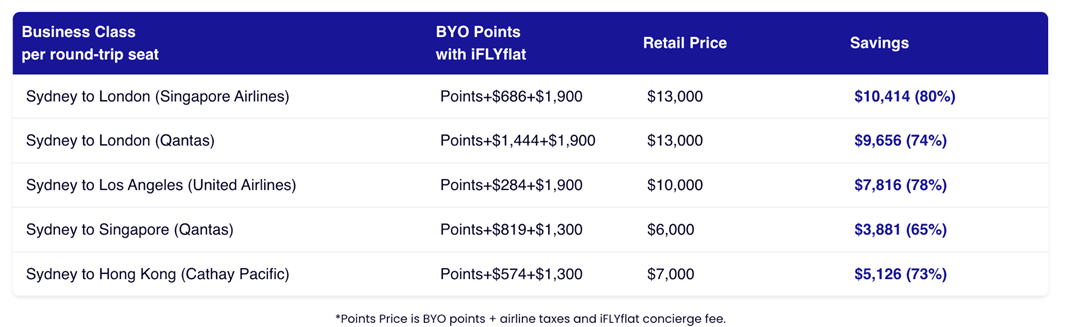
If you’d like to check out Steve’s savings calculator, you can access it at https://www.iflyflat.com.au/flights-club-savings-calculator
Real Risks & Challenges
Overspending & Psychological Temptation
Business credit card reward programs, by design, make spending enticing. After all, if every dollar spent is rewarded, spending more can feel not just justified, but beneficial. This psychological phenomenon aligns closely with two well-documented financial behavioural concepts: Mental Accounting and Parkinson’s Law.
Mental Accounting: Why “Free Points” Lead to Real Costs
Mental accounting is a concept first described by behavioural economist Richard Thaler. It refers to the human tendency to treat money differently based on its perceived source or intended use. Put simply, people mentally separate their money into different categories or “accounts,” leading to less rational spending decisions.
For example:
- Imagine you’ve earned $500 worth of credit card points. Your mind naturally categorises this as “free” or “bonus” money. This perceived freedom often encourages less disciplined spending—you’re more likely to splurge or indulge in unnecessary purchases because you perceive it as separate from your hard-earned cash.
A notable study published in the Journal of Economic Perspectives (Thaler, 1999) found that mental accounting can significantly distort spending decisions, causing consumers to spend “found” money or “bonus rewards” far less carefully than regular income.
Parkinson’s Law: Expenses Expand to Consume Available Resources
Parkinson’s Law, originally articulated by British author Cyril Northcote Parkinson, suggests:
“Work expands so as to fill the time available for its completion.”
Adapted to finance, Parkinson’s Law similarly implies that expenses expand to consume available resources. In the context of credit cards, the “resource” is your credit limit or perceived reward value.
This psychological tendency means that having easy access to credit, even with rewards, often leads to increased spending, simply because the opportunity is available.
Empirical Evidence Supporting Overspending on Credit Cards
Multiple studies empirically validate these psychological phenomena:
- MIT Study (Prelec & Simester, 2001):
Found that consumers were willing to pay up to twice as much for items when paying with a credit card compared to cash. The separation from actual physical cash (mental accounting at play) significantly reduced spending restraint. - Federal Reserve Bank Study (Cole, Thompson & Tufano, 2008):
Highlighted that consumers with rewards cards often spend significantly more than those without, primarily due to subconscious justification:“I’m earning points, so spending more is actually beneficial.” - Journal of Consumer Research (Soman, 2001):
Demonstrated that when spending occurs through methods less psychologically tangible (like credit cards vs. cash), consumers often underestimate their spending, leading to budget overruns.
Many Australian business owners fall into the trap of overspending just to gain points, making the case for a disciplined approach when using business credit cards in Australia.
Our Real-World Safeguard: Disciplined Monthly Reviews
Recognising these psychological risks, we proactively implemented safeguards within our own business experiment:
- Strict Monthly Budget Reviews:
Every expense was meticulously checked against the budget. Any deviation—even minor—triggered an immediate review. - Zero-Tolerance Justifications:
We specifically banned rationalisations like:“It’s okay, we’re earning points anyway.”
Without this strict discipline, it’s easy to justify incremental, seemingly trivial overspending, which quickly compounds into significant unnecessary costs.
Fringe Benefits Tax (ATO Compliance)
One hidden complexity many business owners overlook when using credit card rewards points relates to the Australian Tax Office (ATO) and the potential application of Fringe Benefits Tax (FBT).
Why FBT matters to business credit card users
The ATO considers reward points earned from business expenditure as company property. This means that when those points are redeemed for personal benefit, for instance, upgrading your personal holiday to business class, this usage can trigger an FBT liability.
The ATO’s stance on business credit card rewards in Australia underscores how vital it is to separate personal and business use of points.
Simply put, even though you accumulated points through legitimate business spending, the moment they benefit you personally, the ATO sees it as a taxable benefit provided by your business.
Here’s how this might practically impact you:
A Real-Life Example of FBT Implications
Let’s revisit our earlier redemption example:
- Cairns to Queenstown (business class, Qantas)
- Retail Cost: $1,672
- AMEX points used: 83,000 (transferred at 2:1 to Qantas)
- Estimated value per point: approximately 2c per point
However, if this flight was taken personally (for holidays or leisure), the ATO may classify the entire redemption as a fringe benefit. Here’s what that might look like:
- Benefit value (cash equivalent): $1,672
- FBT Rate (2024-25): 47% approximately
- Potential FBT Liability: ~$786 (47% of $1,672)
This significantly reduces the net benefit of points redemption:
| Redemption Example | Value | With FBT (47% approx.) |
| Flight Value (Cairns–Queenstown) | $1,672 | $2,458 |
| AMEX points cost | 83,000 pts | 83,000 pts |
| Effective Value per point | 2 cents per point | ~1.06 cents per point |
Essentially, your points are suddenly worth half their original calculated value, dramatically shifting the equation of whether the rewards program truly offers worthwhile returns.
Is the ATO actively enforcing this?
The ATO has become increasingly vigilant in recent years regarding credit card points used personally by business owners. Although enforcement historically has been limited, increasing audits have occurred. This means the risk of scrutiny is growing.
What Does the ATO Recommend?
The ATO advises businesses:
- Maintain accurate and detailed records showing points accumulation and usage.
- Clearly differentiate between personal and business-related redemptions.
- Pay Fringe Benefits Tax where required, to avoid penalties or interest in the event of an audit.
Best Practice Tips for Business Owners:
To avoid unexpected tax consequences, clearly define and document your points redemption policy internally:
- Limit usage strictly to business travel or business-related purposes (leadership retreats, client meetings, training).
- Avoid mixing personal and business points redemptions on a single rewards account.
- Keep detailed notes on redemption decisions (date, destination, purpose, justification).
By maintaining clear, transparent records, your business reduces both risk and potential tax liability.
Quick Reference: Amex Platinum Card Pros & Cons
| Criteria | ✅ Pros | ⚠️ Cons |
| Points Accumulation | High (2.25 points per $1) | Significant effort/time to redeem optimally |
| Cash Flow | Up to 55 interest-free days | Complexity in expense tracking |
| Admin & Setup | Manageable (initial setup ~5 hrs) | Monthly monitoring required |
| Redemption Value | Potential high (2–4c per point) | Requires careful research/planning |
| Annual Fees | Clear & Upfront | High fee ($1,750 annually) |
| Overspending Risk | Can be managed with discipline | High temptation (easy credit) |
| Tax & Compliance | Clear guidelines | Personal redemptions are subject to FBT |
FBT implications in Australia; personal point use may trigger tax liabilities.
Objective Conclusion: Who Benefits Most?
Beneficial for:
- Businesses with predictable, substantial monthly spending (>$50K/month).
- Companies with dedicated resources for tracking/redemption.
- Frequent business travellers (maximising lounge, insurance, and premium perks).
Less Beneficial for:
- Businesses with irregular or seasonal income.
- Those lacking disciplined budgeting structures.
- SMEs without dedicated administrative resources.
Is the AMEX Rewards Program Worth Your Time? (A Simple Formula)
One critical element often overlooked when considering credit card rewards programs is the value of your time as a business owner. Points programs may promise financial benefits, but extracting maximum value requires a significant investment of your attention, planning, and administrative time.
Let’s quantify this with a clear example.
Assumptions & Time Costs
Let’s assume your time as a business owner is worth at least $100 per hour. Here’s a realistic breakdown of the minimum time investment required to effectively manage and maximise value from an AMEX Platinum rewards program:
| Task | Time Required | Frequency | Annual Hours |
| Initial Setup (one-time) | 5 hours | Once | 5 hours |
| Planning & Researching Redemptions | 2 hours per quarter | Quarterly (4x) | 8 hours |
| Monthly Cash Flow & Expense Reviews | 1 hour per month | Monthly (12x) | 12 hours |
| Total Annual Time Commitment | 25 hours |
At an hourly value of $100, the annual time cost equates to:
25 hours × $100/hour = $2,500 per year
Calculating Your Minimum Spend Threshold
To make your rewards program worthwhile, you must generate enough benefits to cover the $2,500 annual time investment (in addition to covering the annual card fee of $1,750):
- Annual Time Cost: $2,500
- Annual Card Fee: $1,750
- Total Annual Cost (Time + Fee): $4,250
Given that the baseline value of AMEX points is approximately 1 cent per point (assuming no complex optimisations), your rewards points must generate at least $4,250 annually just to break even.
Here’s the simple formula to evaluate your minimum annual spend to justify this investment:
Minimum Annual Spend = Annual Cost (Time + Fee) / Points Value per Dollar Spent
Given AMEX Platinum typically earns around 2.25 points per $1 spent (as our experiment showed):
- 25 points per dollar = $0.0225 earned per $1 spent (at 1 cent per point)
Therefore:
Minimum Annual Spend=$4,250 / 0.0225 = $188,889
Result:
You must spend at least ~$189,000 annually (or ~$15,750 monthly) to justify your time investment in the AMEX Platinum Card at a basic 1c/point valuation.
Adjusting for Higher Redemption Value
If you consistently achieve higher redemption values (e.g., 2 cents per point through careful planning), your required spend threshold drops accordingly:
- At 2 cents per point, the value of your point doubles to $0.045 per $1 spent:
Minimum Annual Spend=$4,250 / 0.045 = $94,444
In this scenario, your required annual spending threshold drops to approximately $95,000 (~$7,900 monthly).
Final Thoughts & Opinions (Our Experience)
If you’re weighing up business credit card comparison in Australia, this case study reveals the true value—and hidden costs—of using the AMEX Platinum Business Card Australia.
(Note: This section represents our informed professional opinion based on extensive financial advisory experience. It should not be taken as advice.)
Most business owners chase credit card rewards, hoping for incremental gains of around 2–3% per year. But from our experience advising thousands of Aussie businesses, we’ve noticed something interesting:
Most businesses are unintentionally leaving far more than 2–3% of their profits on the table due to hidden inefficiencies, overspending, and weak cash-flow discipline.
Instead of chasing points, consider this alternative:
What if you could guarantee yourself 15–20% more profit each year, without complicated credit card programs, high annual fees, or obscure redemption rules?
That’s exactly what our Profit Mastery Machine does. It might not sound as sexy as airport lounges and business-class flights, but trust me—it’s infinitely more profitable.
The Profit Mastery Machine – What Is It, and How Does It Work?
The Profit Mastery Machine is a straightforward, disciplined cash-flow management system that gives you absolute clarity, consistency, and confidence around your business finances.
Here’s how it works practically:
Your revenue flows weekly into one main income account. Each week, that revenue is then deliberately allocated (using predetermined percentages) into clearly defined “buckets”:
- Income Bucket:
Your single holding account for all business revenue. - Profit Bucket (15–20%)
Your reward for owning the business and building your long-term wealth. - Owner’s Pay Bucket (30%)
Funds your regular, reliable personal salary each month. - Operating Expenses Bucket (30%)
Covers all necessary fixed and variable business expenses—nothing more, nothing less. - Tax Bucket (20%)
Set aside to effortlessly meet your GST, PAYG, and company tax obligations without surprises.
The golden rule of the Profit Mastery Machine is simple but powerful:
“If the money isn’t in the bucket, you can’t spend it-no exceptions.”
Why This Actually Works (With Real-World Examples)
Imagine your revenue this week is exactly $25,000. Under our system, it’s immediately divided:
- Profit: $5,000 (20%)
- Owner’s Pay: $7,500 (30%)
- Operating Expenses: $7,500 (30%)
- Tax: $5,000 (20%)
Now, let’s say a shiny, tempting opportunity comes up—maybe a new subscription software that costs $1,000/year. It might seem harmless, but when you check your OPEX bucket, you realise it’s empty because funds were already allocated. Now you have three choices:
- Defer: Wait until next month when funds are available.
- Find extra revenue: Drive new sales immediately.
- Cut another expense: Prioritise your spending clearly.
Suddenly, your spending decisions become crystal-clear and intentional, completely removing impulse or emotionally driven overspending.
Profit Mastery vs AMEX Platinum: Head-to-Head Comparison
Let’s objectively compare using our AMEX Platinum experiment and the Profit Mastery Machine system:
| Metric | AMEX Points Strategy | Profit Mastery Machine |
| Potential Return | 2–4% (at best) | 15–20% consistently |
| Complexity | High (monthly management, research) | Low (simple weekly allocation) |
| Overspending Risk | High (easy credit temptation) | Virtually eliminated |
| Cash Flow Control | Moderate (expenses deferred, can obscure clarity) | High (transparent allocations) |
| Tax Implications | Moderate/High (FBT risks) | None (completely compliant) |
| Administrative Time | Significant (hours monthly) | Minimal (minutes weekly) |
The Hybrid Experiment: Profit Mastery + AMEX Platinum
To genuinely test our hypothesis fairly, we integrated the AMEX Platinum Card into our existing Profit Mastery structure. Here’s exactly how:
- Extra Allocation: We increased our Profit Bucket allocation from 20% to 22%, deliberately creating a cash-flow buffer that is equal to the AMEX rewards points benefits. Essentially, creating our own rewards program with our own cash.
- Zero-Fee Expenses: We strictly limited AMEX usage to recurring, surcharge-free expenses (like digital ads on Google or Facebook), guaranteeing predictable points accumulation.
- Automated AMEX Payments: We auto-cleared our monthly AMEX balance from our OPEX bucket, removing any risk of interest or overspending.
But even with these tight controls, the additional time spent managing redemption complexities and the minor improvements to cash flow made the benefit only slightly better than neutral.
Our Honest Opinion
Our experiment showed that reward points can add some value to disciplined businesses.
However, achieving that value requires significant effort and discipline that most businesses realistically struggle to sustain.
From our observations, less than 10% of business owners consistently maintain this discipline long-term.
For the other 90%, chasing points usually becomes a dangerous distraction, potentially costing far more than they’re worth.
You must confidently be able to answer the following questions;
- I have separated out all of my personal expenses from the business, and it is clear what is business and what is personal
- I have a clear strategy for how to use the card for fixed and budgeted expenses
- I have a mechanism to control overspending and using the credit card to justify expenses
- I have a system to allocate my inflows to ensure I can pay the entire credit card off on time and in full without interest
- I have the time and energy to research and learn the rewards program and extract value from it
- I have enough business-related travel to use the points for and avoid the Fringe Benefits Tax for personal usage
If you cannot, you’re best not to use a credit card.
Personally, I will continue to run the rewards program experiment for the rest of the year and update our findings. I am leaning towards cancelling it and going back to cash.
Want Tailored Advice for Your Business?
If you’re unsure which business credit card suits your needs in Australia, or how to legally and strategically maximise AMEX rewards, book a call with our experts.
Book your complimentary consultation with Aureus Financial today. We’ll explore your numbers objectively and then build your path to clarity, profit, and genuine financial freedom.
Book Your Free Consultation Now →
We specialise in guiding Australian businesses on how to maximise business credit card rewards programs without falling into cash flow traps or FBT issues.
Disclaimer: This case study is based on real experiences and presented objectively. However, individual circumstances may vary, and this does not constitute personalised financial advice. Always consult with a professional advisor before making decisions.
